Chihiro Sakai (M1) of the Cybernetics and Reality Engineering Laboratory received the Research Encouragement Award (Gold Prize) at the 75th Entertainment Computing Research Presentation.
This research presentation is organized by the Special Interest Group on Entertainment Computing (SIGEC) of the Information Processing Society of Japan (IPSJ). Its purpose is to promote “technical research for creating new entertainment,” “evaluation and elucidation of ‘fun’,” and “applied research in education, welfare, and sports.” It serves as a forum for presenting and discussing research results that lead the development of the entertainment computing field. The 75th Entertainment Computing Research Presentation (SIGEC2025) was held at Kyoto University from March 17 to 19, 2025.
The research presented by Ms. Sakai, titled “Development of a Robot System for People with Physical Disabilities to Realize Gaze Visualization and Visual Search Support,” enables individuals with severe physical disabilities to understand their surroundings using a robot controllable by eye-gaze and to communicate their intentions or interests to others through gaze visualization. Its originality and social significance were highly evaluated. Following this award, further progress in research and its application to the real world are highly anticipated.
Awardees/Authors:
Chihiro Sakai (1st-year Master’s Course), Ory Yoshifuji (Ory Laboratory Inc.)
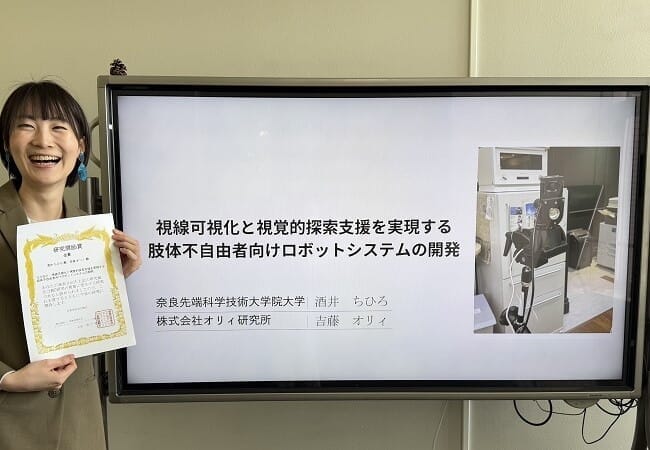
Photo: Chihiro Sakai
Research theme:
“Development of a Robot System for People with Physical Disabilities to Realize Gaze Visualization and Visual Search Support”
Currently, many people in Japan face difficulties in daily life due to physical disabilities. Depending on the impact of the disability, their field of vision may be limited, or they may find speech difficult. These factors create challenges such as difficulty in noticing approaching dangers while moving, or limitations in communicating the intent to ask others to move or operate objects, significantly reducing the convenience of daily life.
To solve these issues, this research developed a robot system aimed at visualizing the user’s point of focus and supporting visual search for individuals with physical disabilities. The robot is equipped with a directional light and a camera, capable of pan-and-tilt movements, and can be easily operated via a graphical user interface on a PC. The directional light visualizes the point of focus, functioning as a pseudo-“pointing” gesture to inform caregivers and others of what the user is looking at. Additionally, the robot’s pan-and-tilt motion allows the user to look at any location they desire.
As a result of trials conducted with two patients with Amyotrophic Lateral Sclerosis (ALS), the practical utility of the robot was recognized, and feedback on several areas for improvement was obtained.
Awardee’s voice
“It is a great honor to receive such a prestigious award. I would like to express my deep gratitude to those who participated in the usability evaluation, everyone at Ory Laboratory, Mr. Ory Yoshifuji for providing various experiences such as technical skill transfer and event participation, and the professors at the Cybernetics and Reality Engineering Laboratory for encouraging my participation in the internship. I plan to continue the research and development of this system as a joint project with Ory Laboratory and further evolve it so that it can be used by even more people.”
Link to:
IPSJ SIG Entertainment Computing (SIGEC) HP: https://sig.entcomp.org/
